Arizona LLCs
Frequently Asked Questions
Written by Arizona LLC attorneys Richard Keyt (Rick 480-664-7478 & [email protected]) and his son and law partner former CPA Richard C. Keyt (Ricky 480-664-7472). & [email protected]).. Book a free offfice, phone or Zoom meeting using our online calendar.
Navigating the rules of starting and running a business in Arizona can be complex, but getting it right is crucial to protecting your assets. Written by experienced Arizona LLC attorneys who have formed over 10,000 limited liability companies and who have 407 five-star Google, Facebookand Birdeye reviews, this comprehensive FAQ guide provides clear, legally accurate answers to the most common questions about Arizona LLCs.
Whether you are ready to form a new company, need help operating an existing one, or want to understand how to transfer real estate to your LLC, browse our in-depth guides below. Select a topic to find the answers you need to protect yourself and your business.
Last Updated: June 21, 2026
Top 10 Most Common Arizona LLC Questions
How much does it cost to form an Arizona LLC?
The Arizona Corporation Commission charges a $50 filing fee for regular processing or $85 for expedited processing of your Articles of Organization. If you hire KEYTLaw to form your LLC, our packages start at $497 for the Bronze package, which includes drafting and filing the Articles of Organization. Our Silver package ($897) adds a custom Operating Agreement, an EIN, and our 170-page Arizona LLC Operations Manual.
How long does it take to form an Arizona LLC?
When KEYTLaw is hired and paid, we get your Articles of Organization approved the same day. Regular ACC processing without expediting takes about 30 days, expedited paper filing takes 5-7 days, and expedited online filing can be approved in as little as 10 minutes.
Does an Arizona LLC need a Statutory Agent?
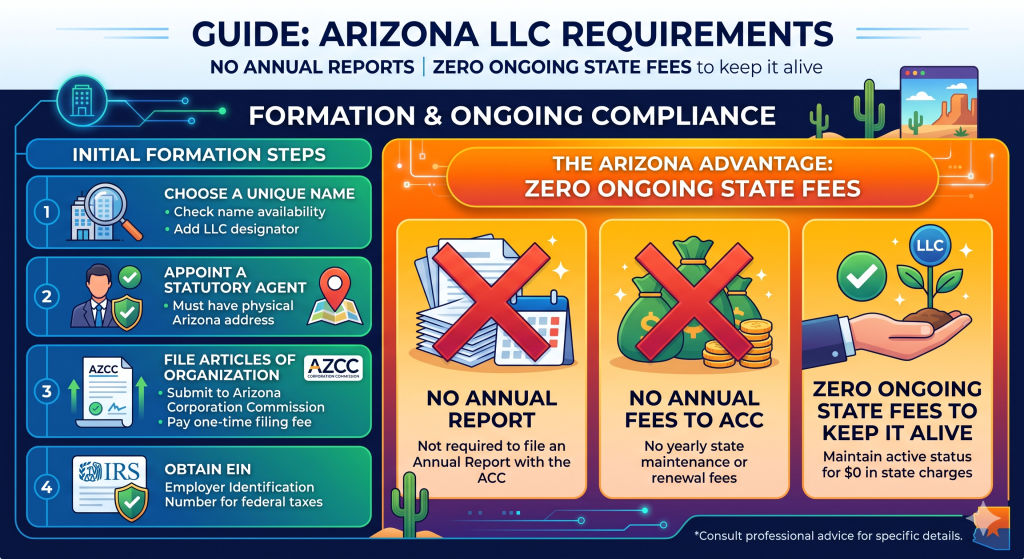
Yes. Every Arizona LLC must designate a Statutory Agent, also called a Registered Agent, to receive official legal and state documents on the LLC's behalf. The agent must maintain a physical street address in Arizona (not a PO Box) and be available to accept legal notices and forward them promptly to the LLC.
Does Arizona require LLCs to file an annual report or pay an annual fee?
No. Unlike most states, Arizona does not require LLCs to file an annual report or pay an annual renewal fee. Once your LLC is approved, it stays in good standing indefinitely with no recurring state fees, which makes Arizona one of the most affordable states for maintaining a business entity.
Do I need an Operating Agreement for my Arizona LLC?
Arizona law does not legally require an LLC to have an Operating Agreement, but operating without one is risky. Without a signed agreement, your LLC defaults to Arizona's statutory rules, which split profits and voting power equally among members regardless of how much each member actually contributed or owns. A custom Operating Agreement overrides these defaults and gives you legal proof of ownership that banks, title companies, and courts require.
How is an Arizona LLC taxed?
The IRS does not have a separate tax category for LLCs. By default, a single-member LLC is taxed as a disregarded entity (like a sole proprietorship), and a multi-member LLC is taxed as a partnership. LLC owners can also elect to have the LLC taxed as an S corporation or C corporation if that classification produces a better tax outcome for their situation.
Can a minor own an interest in an Arizona LLC?
Yes. Arizona law has no minimum age requirement for LLC members, so a child under 18 can legally own a membership interest. However, because minors cannot enter into binding contracts, they cannot sign agreements or open bank accounts for the LLC. An adult manager, parent, guardian, or trust typically needs to handle the LLC's legal and financial obligations on the minor's behalf.
What happens to my Arizona LLC if I die without a plan?
Without proper planning, your LLC membership interest does not automatically pass to your loved ones. It must go through Arizona probate unless the value of your personal property is under $200,000, and your heirs may inherit only an economic interest with no voting or management rights. Transferring your LLC interest into a revocable living trust, or holding it as community property with right of survivorship for married couples, allows the interest to pass automatically and avoid probate.
How do I add or remove a member from my Arizona LLC?
Adding or removing a member requires three steps: signing a written Assignment of Membership Interest to transfer ownership, updating the LLC's Operating Agreement to reflect the new membership structure, and filing an Amendment to the Articles of Organization with the Arizona Corporation Commission. Skipping any of these steps can leave your LLC's ownership records legally unclear.
How do I dissolve or terminate an Arizona LLC?
Terminating an Arizona LLC is a two-phase process: first winding up the business by paying debts and distributing remaining assets in the order required by law, then filing Articles of Termination with the Arizona Corporation Commission. The tax consequences of dissolving depend on how the IRS classifies your LLC, so it's worth reviewing both the legal and tax sides before you start the process.
LLC Frequently Asked Questions
Table of Contents
Forming an Arizona LLC
FAQ: Arizona LLC Formation Services
FAQ: Contents of Our 3 LLC Formation Packages
FAQ: What is an Arizona Statutory Agent & Its Requirements?
FAQ: How to Open a Bank Account for an Arizona LLC
FAQ: How to Get an EIN for an Arizona LLC
FAQ: LLC Taxation Explained: 4 Ways the IRS Taxes LLCs
FAQ: Arizona LLC Membership: Community vs. Separate Property
FAQ: How to Make Your AZ LLC Your Sole & Separate Property
FAQ: Can a Child Under 18 Own an Interest in an Arizona LLC?
FAQ: California's $800 LLC Tax: Guide for CA Residents
Operating & Managing an Arizona LLC
FAQ: How to Fund an Arizona LLC : Capital Contribution or Loan
FAQ: Member Loans to an Arizona LLC: Tax & Legal Rules
FAQ: AZ LLC Default Allocation of Profits, Votes & Distributions
FAQ: No Operating Agreement? How AZ Allocates LLC Profits
FAQ: 19 Arizona LLC Operating Agreement FAQs
FAQ: Does an Arizona LLC Have to File a Report or Pay a Fee?
FAQ: How to Get a Trade Name / DBA in Arizona
FAQ: How to Amend an Arizona LLC's Articles of Organization
FAQ: How to Change, Replace, or Resign an Arizona Statutory Agent
FAQ: How Do I Make a Gift of My Arizona LLC Interest?
FAQ: LLC Owners: How to Legally Hire & Pay Your Child
FAQ: What Happens to Your Arizona LLC When You Die?
Adding, Removing & Protecting LLC Members
FAQ: How to Prove Members of an Arizona LLC
FAQ: How to Add or Remove a Member of an Arizona LLC
FAQ: How Members of an LLC Pay Themselves
FAQ: Arizona LLC Meetings: Rules, Minutes & Requirements
FAQ: Arizona LLC Member Disputes: Guide to an LLC Divorce
FAQ:: Resolving Arizona LLC Member Disputes: 6 Legal Options
FAQs about Buy-Sell Agreements for Multi-Member LLCs
Transferring Real Estate & Property to an Arizona LLC
FAQ: Why an Arizona LLC Should Own Your Rental Property
FAQ: How to Transfer Rental Property to an AZ LLC (Includes Notice Letter to Tenant)
FAQ: How to Insure Rental Property Transferred to an LLC
FAQ: How to Transfer Land to an LLC & Avoid a Due on Sale
FAQ: Does Transferring Land to LLC Trigger a Due on Sale Clause?
Dissolving & Closing an Arizona LLC
The FAQs
FAQ: Arizona LLC Formation Services
This comprehensive FAQ provides authoritative legal and administrative details on forming an Arizona LLC. Key topics covered include:
Costs & Filing Fees: Details on the Arizona Corporation Commission (ACC) $50 regular and $85 expedited filing fees.
Processing Timelines: We get Articles of Organization approved the same day we are hired and paid. Expected ACC approval times, including 30-day regular processing, 5-7 day expedited paper processing, and instant/10-minute online expedited processing.
Publication Requirements: Rules regarding when an LLC must publish a notice in a local newspaper (required for statutory agents located outside Maricopa and Pima counties). When we are the statutory agent we are in Maricopa County so publication is not required.
Taxation: An overview of the four ways an LLC can be taxed by the IRS (sole proprietorship, partnership, C-corporation, etc.).
Formation Options: A comparison between a 10-step Do-It-Yourself online formation process and hiring KEYTLaw using their Bronze, Silver, or Gold (confidential) LLC packages.
FAQ: Contents of Our 3 LLC Formation Packages
This FAQ details the Arizona LLC formation services and Frequently Asked Questions (FAQ) provided by KEYTLaw, an Arizona law firm led by attorneys Richard Keyt and Richard C. Keyt. The firm has formed over 10,000 LLCs and offers three tiered formation packages that feature same-day document preparation and lifetime free legal support for LLC-related questions:
Bronze Package ($497): Covers the essential LLC formation services, including drafting and filing the Articles of Organization with the Arizona Corporation Commission (ACC).
Silver Package ($897): The firm's most popular tier. It includes everything in the Bronze package, plus the preparation of a custom LLC Operating Agreement, obtaining an Employer Identification Number (EIN) from the IRS, and access to the comprehensive 170-page Arizona LLC Operations Manual.
Gold Package ($1,397): Designed for privacy and estate planning, this “Confidential LLC” package includes all Silver features plus a custom revocable living trust. This trust keeps the owner's name and home address off the ACC's public records and ensures the LLC can pass to heirs without going through probate.
The FAQ section clarifies important procedural details, including ACC processing timelines (regular vs. expedited filing fees), the legal necessity of having a well-written Operating Agreement for asset protection, statutory agent requirements, and the step-by-step process for hiring KEYTLaw either online or by telephone.
Watch our video about Forming a Confidential Arizona LLC that keeps your name and address off the public records of the Arizona Corporation Commission.
This overview from the attorneys directly explains their Bronze, Silver, and Gold LLC packages, providing helpful context on how the confidential trust structure protects a business owner's public information.
FAQ: What is an Arizona Statutory Agent & Its Requirements?
Every Arizona LLC and corporation must designate a Statutory Agent (sometimes called a “Registered Agent”) to receive official legal and state documents. This mandatory point of contact ensures your business stays compliant with the Arizona Corporation Commission (AZCC).
Who can be an agent? An Arizona resident or a business entity authorized to act as an SA, provided they maintain a physical street address in the state (not a PO Box) and are publicly accessible.
What are their duties? The agent must have a physical presence, accept legal notices promptly, and forward all crucial documents to your LLC.
How do you change one? A specific “Statement of Change” form must be filed directly with the AZCC.
FAQ: How to Open a Bank Account for an Arizona LLC
This FAQ guide by Arizona LLC attorneys at KEYTLaw explains the steps and requirements for opening a business bank account for a newly formed Arizona Limited Liability Company (LLC). It details the essential documents banks require, including an IRS-issued Employer Identification Number (EIN), approved Articles of Organization from the Arizona Corporation Commission (ACC), and an LLC Operating Agreement. The article also highlights the legal importance of using a dedicated business bank account to separate finances, maintain the corporate veil, and protect personal assets from business liabilities
FAQ: How to Get an EIN for an Arizona LLC
This FAQ covers:
Topic: How to get an Employer Identification Number (EIN) for an Arizona Limited Liability Company (LLC).
Authors: Richard Keyt and Richard C. Keyt, Arizona LLC and estate planning attorneys.
Core Concept: Every new Arizona LLC requires a federal EIN to legally operate and maintain corporate formalities, most notably to open a business bank account.
Content: A comprehensive FAQ section answering the most common questions new LLC owners have regarding the rules, requirements, and steps to apply for an EIN with the IRS.
FAQ: LLC Taxation Explained: 4 Ways the IRS Taxes LLCs
This FAQ page, authored by Arizona LLC attorneys Richard Keyt and Richard C. Keyt, explains how Limited Liability Companies (LLCs) are taxed by the IRS and the state of Arizona. It clarifies that the IRS does not have a specific tax category for LLCs, detailing the default tax classifications for single-member LLCs (disregarded entities) and multi-member LLCs (partnerships), as well as how business owners can elect to have their LLC taxed as an S Corporation or C Corporation.
FAQ: Arizona LLC Membership: Community vs. Separate Property
This FAQ explains how Arizona's community property laws affect Limited Liability Company (LLC) ownership for married individuals. Because Arizona is a community property state, any LLC membership interest acquired during marriage is legally presumed to be owned jointly by both spouses. This article details the differences between community and separate property, the legal steps required to classify an LLC interest as separate property (such as executing a Spousal Consent or Disclaimer), and how these classifications impact asset protection, divorce, and estate planning.
FAQ: How to Make Your AZ LLC Your Sole & Separate Property
This FAQ explains why married individuals who form an Arizona LLC without their spouse must have the non-owner spouse sign a disclaimer. Because Arizona is a community property state, signing a spousal disclaimer ensures that the LLC membership interest is legally protected and classified as the owner spouse's sole and separate property, rather than joint community property.
FAQ: Can a Child Under 18 Own an Interest in an Arizona LLC?
Yes, a minor can own an interest in an Arizona LLC because Arizona law does not have a minimum age requirement for LLC members. However, because minors lack the legal capacity to enter into legally binding contracts, they cannot sign agreements, open business bank accounts, or actively manage the company. To operate successfully, an LLC with a minor member typically requires an adult manager, parent, guardian, or a trust to handle the business's legal and financial obligations.
FAQ: California's $800 LLC Tax: Guide for CA Residents
Are you a California resident who has formed—or is considering forming—an out-of-state LLC, such as in Arizona, to bypass California's mandatory $800 minimum annual franchise tax?
While this is a popular strategy, many residents inadvertently trigger this substantial tax liability and face expensive penalties.
This legal guide, written by Richard Keyt, provides a clear explanation of how the California Franchise Tax Board (FTB) views out-of-state LLCs with California-resident members. We unpack the critical, often confusing concepts that determine tax liability, including:
When an out-of-state LLC is legally considered to be “Doing Business” in California.
The essential distinction between Active Members and Passive Members, and why it matters for the $800 tax.
The specific conditions under which a California resident's out-of-state LLC is truly exempt from the annual tax.
Read this FAQ before making a final decision, as understanding these complex rules is vital to ensure legal compliance and avoid a surprise tax bill.
Operating an Arizona LLC FAQs
FAQ: How to Fund an Arizona LLC : Capital Contribution or Loan
When funding a newly formed LLC, members must legally classify their financial input as either a capital contribution (equity) or a member loan (debt). This classification dictates the LLC’s tax treatment, the member's asset protection, and the priority of repayment during liquidation. Proper legal documentation is critical to avoid IRS penalties or recharacterization.
Key Takeaways
Capital Contributions (Equity): Funds or property transferred in exchange for an ownership interest. It increases the member's capital account and tax basis. However, contributing members are equity holders, meaning they are paid last in the event of an LLC liquidation.
Member Loans (Debt): The member lends funds to the LLC, establishing themselves as a creditor. This provides priority repayment over equity holders during dissolution. The LLC can deduct interest payments as a business expense, while the member reports the interest as ordinary income.
Promissory Note Compliance: To be legally recognized by the IRS and courts, a member loan must be backed by a written promissory note. The note requires a fixed repayment schedule, a maturity date, and an interest rate at or above the IRS Applicable Federal Rate (AFR). Failure to do so risks the IRS recharacterizing the loan as a capital contribution.
Member Resolutions: Both funding methods legally require a formal “Member Resolution” (Consent of Members). This written authorization establishes a contemporaneous paper trail, protects creditor status, and gives exact bookkeeping instructions to the LLC's CPA.
FAQ: Member Loans to an Arizona LLC: Tax & Legal Rules
This article by Arizona LLC attorney Richard Keyt provides a comprehensive guide on the legal, tax, and practical rules for when a member loans money to an Arizona LLC.
Key Takeaways:
Legality: Arizona law allows LLC members to loan money to their LLCs, provided the transaction is handled correctly.
Documentation: The loan must be formalized with a written promissory note signed by the LLC and should be recorded as a liability on the LLC’s books, rather than as a capital contribution.
Tax Rules: The loan must charge an interest rate that is at least equal to the IRS Applicable Federal Rate (AFR). If the transaction lacks the standard characteristics of true debt, the IRS may recharacterize the loan as a capital contribution, which can lead to adverse tax consequences.
Protection: Lending members should consider securing the loan with a UCC lien or a deed of trust against the LLC's assets.
Approval & Priority: Whether the loan requires approval from other members depends on the LLC's operating agreement. The article also covers the lending member's priority in the event of default or company dissolution.
This FAQ serves as a complete roadmap for both single-member and multi-member Arizona LLCs to ensure member loans are legally sound and tax-compliant.
FAQ: AZ LLC Default Allocation of Profits, Votes & Distributions
Without a written Operating Agreement, an Arizona LLC defaults to the rules of the Arizona Limited Liability Company Act. By default, Arizona law dictates that all profits, financial distributions, and management votes are divided equally among all LLC members. This means a member who contributes $99,000 gets the exact same profit share and voting power as a member who contributes $1,000. To allocate profits and votes based on actual ownership percentages, you must have a custom Operating Agreement drafted by an Arizona LLC attorney.
FAQ: No Operating Agreement? How AZ Allocates LLC Profits
If an Arizona multi-member LLC does not have an operating agreement, Arizona LLC law (A.R.S. § 29-3401) dictates that profits, losses, and distributions are allocated based on the value of each member's capital contributions—not divided equally or by ownership percentage. In this guide, Arizona LLC attorney Richard Keyt explains these default rules, how they can trigger surprise tax bills, and why drafting a custom operating agreement is essential to protect your business.
FAQ: 19 Arizona LLC Operating Agreement FAQs
Quick Summary: Do you need an Operating Agreement for an Arizona LLC? While Arizona law does not legally require an LLC or PLLC to have an Operating Agreement, operating without one leaves your business vulnerable to Arizona’s default LLC statutes. Without a comprehensive, signed agreement, the state dictates how your company is run.
Skipping an Operating Agreement can severely harm your business by:
Splitting profits equally, regardless of each member's actual ownership percentage or financial investment.
Granting equal voting rights to all members, meaning a 10% owner has the same power as a 90% owner.
Failing to provide legal proof of ownership, which banks, title companies, and courts require.
In this FAQ Arizona LLC attorneys Richard Keyt and Richard C. Keyt answer the 19 most frequently asked questions about LLC Operating Agreements, explaining how a custom contract overrides state defaults to protect your assets, your partners, and your company.
FAQ: Does an Arizona LLC Have to File a Report or Pay a Fee?
Unlike most states, Arizona does not require LLCs to file an annual report or pay an annual renewal fee to the Arizona Corporation Commission. Once your Arizona LLC is approved, it remains in good standing indefinitely without any recurring state renewal fees, making Arizona one of the most budget-friendly states in the country for maintaining a business
FAQ: How to Get a Trade Name / DBA in Arizona
Arizona Trade Name (DBA) Quick Facts:
What is it? A DBA (“Doing Business As”) allows you to legally operate a business under a name other than your personal or legal entity name.
Where to register: Trade names are filed with the Arizona Secretary of State.
How long does it last? An Arizona trade name registration is valid for five years before it must be renewed.
Does it protect my name? No. Unlike a trademark, registering a trade name in Arizona does not grant exclusive legal rights to the name.
Read our complete FAQ above to learn exactly how to register your DBA, check name availability, and ensure your Arizona business is legally compliant.
FAQ: How to Amend an Arizona LLC's Articles of Organization
If your Arizona LLC changes its name, adds or removes a member, or updates its managers, Arizona law requires you to file an Amendment to your Articles of Organization with the Arizona Corporation Commission (ACC) within 30 days. Failing to report these changes on time puts your business at risk of administrative dissolution. In this FAQ, experienced Arizona LLC attorneys Richard Keyt and Richard C. Keyt answer your most common questions about filing deadlines, ACC fees, and the step-by-step process for successfully amending your Arizona LLC to keep your company in good standing.
FAQ: How to Change, Replace, or Resign an Arizona Statutory Agent
Need to change or replace the statutory agent for your Arizona LLC? This complete guide explains the four-step process to update your statutory agent under ARS Section 29-3116. It also covers the legal requirements for an agent to resign without the LLC's permission (ARS Section 29-3117) and the serious risk of administrative dissolution if your LLC fails to appoint a replacement within 60 days
FAQ: How Do I Make a Gift of My Arizona LLC Interest?
To gift an Arizona LLC membership interest, you must legally transfer your ownership percentage to another person or entity. The exact process depends on whether your Arizona limited liability company has an Operating Agreement and if that agreement restricts membership transfers. Generally, making a gift requires a written Assignment of Membership Interest document and approval from the other LLC members.
The process generally requires these steps:
- Review your Operating Agreement for transfer restrictions.
- Obtain consent from existing members, if required.
- Sign a written Assignment of Membership Interest document.
- Update your LLC records to reflect the new ownership.”
FAQ: LLC Owners: How to Legally Hire & Pay Your Child
An Arizona LLC can legally hire a business owner's child. According to Arizona LLC attorneys Richard and Ricky Keyt, the IRS allows this as long as the child performs actual, age-appropriate duties and receives reasonable compensation. Hiring your minor child through a single-member LLC can legally shift income to a lower tax bracket and save you money on Medicare, Social Security, and unemployment taxes.
FAQ: What Happens to Your Arizona LLC When You Die?
When an Arizona LLC member dies, their membership interest does not automatically transfer to their loved ones. Without proper planning, the LLC interest must go through a costly, time-consuming Arizona probate process unless the total value of the deceased member's personal property is less than $200,000. Your heirs may inherit only an “economic interest” with absolutely no voting or management rights.
Fortunately, you can completely avoid probate and ensure a seamless transition of your business by establishing an Arizona LLC transfer on death strategy. The most effective ways to legally transfer your LLC membership interest upon death include:
Transferring your LLC ownership into a Revocable Living Trust.
- Holding the LLC interest as Community Property with Right of Survivorship (for married couples). This causes the interest of the deceased spouse to pass automatically to the surviving spouse
Read our Frequently Asked Questions above to learn how to protect your Arizona LLC from the probate court.
Arizona LLC Member Issues FAQs
FAQ: How to Prove Members of an Arizona LLC
To prove you are a member of an Arizona LLC, the most definitive legal document is a fully signed, written Operating Agreement. Because the Arizona Corporation Commission (ACC) does not issue membership certificates or track LLC ownership percentages, banks, title companies, and courts rely on your Operating Agreement as official proof of your LLC membership.
FAQ: How to Add or Remove a Member of an Arizona LLC
To legally add or remove a member of an Arizona LLC, you must complete three essential steps: (1) execute a written Assignment of Membership Interest from the current member to the new member that transfers ownership, (2) update the LLC's Operating Agreement to reflect the new member structure, and (3) file an Amendment to the Articles of Organization with the Arizona Corporation Commission (ACC). Read our frequently asked questions below to learn exactly how to change your LLC's ownership, avoid common legal mistakes, and keep your business compliant.
FAQ: How Members of an LLC Pay Themselves
Members of an LLC typically pay themselves using one of three methods, depending on how the company is taxed:
Owner’s Draws (Distributions): For LLCs taxed as sole proprietorships or partnerships, members transfer profits directly to their personal accounts. These draws are subject to self-employment taxes.
W-2 Salary: If the LLC elects to be taxed as an S-Corporation, active members must pay themselves a ‘reasonable salary' through payroll. Remaining profits can then be taken as tax-advantaged distributions.
Guaranteed Payments: In multi-member LLCs, members can receive fixed payments for their services or capital, regardless of the business's profitability.”
FAQ: Arizona LLC Meetings: Rules, Minutes & Requirements
Arizona LLC law does not require a limited liability company to hold annual member or manager meetings, nor does it require formal meeting minutes. However, if your LLC's Operating Agreement mandates annual meetings, you are legally required to hold them. Even though the state does not require it, voluntarily holding meetings and documenting major company decisions with written minutes is a highly recommended best practice to maintain your corporate veil and protect your personal assets.
FAQ: Arizona LLC Member Disputes: Guide to an LLC Divorce
Navigating an Arizona LLC member dispute without a buy-sell agreement can be complex and stressful. In this FAQ, experienced Arizona LLC attorneys Richard Keyt and Richard C. Keyt answer common questions about ‘LLC divorces,' resolving business partner conflicts, negotiating member buyouts, and understanding your legal rights under Arizona law. Read on for clear, actionable guidance on the best exit strategies to protect your financial interests when members can no longer work together.
FAQ:: Resolving Arizona LLC Member Disputes: 6 Legal Options
When facing an Arizona LLC member dispute, members generally have six legal options to resolve disagreements over operations, management, or funding:
Direct Negotiation: Informal resolution directly between members.
Mediation: Facilitated negotiation utilizing a neutral third party.
Binding Arbitration: Private, out-of-court resolution decided by an arbitrator.
Member Buyout: Purchasing the dissenting member’s ownership interest.
Voluntary Termination: Mutually agreeing to dissolve the LLC.
Judicial Termination: Filing a lawsuit for court-ordered dissolution under A.R.S. § 29-3708.
Note: If your LLC has an Operating Agreement it may govern which of these resolution methods are required or available to you.
FAQs about Buy-Sell Agreements for Multi-Member LLCs
Welcome to our comprehensive FAQ guide on Buy-Sell Agreements for Multi-Member LLCs. Authored by trusted Arizona business attorneys who have formed over 10,000 LLCs, this page provides authoritative answers on:
The basics: What an LLC buy-sell agreement is and why your business needs one.
Triggering events: How to handle a member's death, disability, bankruptcy, or retirement.
Member buyouts: How to value ownership interests and structure a seamless transition of power.”
Transferring Land to an Arizona LLC FAQs
FAQ: Why an Arizona LLC Should Own Your Rental Property
Why an LLC should own your Arizona rental property:
Personal Liability Protection: Shields your personal home, assets and savings from tenant lawsuits and property injuries.
Asset Isolation: Prevents a lawsuit on one rental property from affecting your other real estate investments.
Tax Advantages: Offers flexible pass-through taxation without complicating your personal tax returns.
FAQ: How to Transfer Rental Property to an AZ LLC (Includes Notice Letter to Tenant)
Transferring a rental property to an Arizona LLC is a smart asset-protection strategy, but the process doesn't end with the transfer. To maintain your limited liability protection and comply with Arizona landlord-tenant laws, your LLC must immediately record the deed with the county, send a formal change-of-ownership notice to tenants, transfer security deposits into a dedicated LLC bank account, and update property insurance and tax registrations.
FAQ: How to Insure Rental Property Transferred to an LLC
When you transfer rental property to an LLC, your personal homeowner's insurance will no longer cover the property. To maintain your asset protection and prevent coverage gaps, you must replace your personal policy with a landlord policy issued in the LLC's name, secure LLC liability coverage, and add yourself personally as an additional insured.
FAQ: How to Transfer Land to an LLC & Avoid a Due on Sale
Yes, you can avoid a due-on-sale clause when transferring mortgaged property to an LLC by utilizing federal exemptions. For this to be a permitted transaction, you must meet three main requirements:
Fannie Mae or Freddie Mac Loan: Your mortgage must be owned or guaranteed by one of these federal agencies.
Borrower Control: The original borrower must maintain ownership and control of the LLC.
Account in Good Standing: You must continue making timely mortgage payments.
Meeting these federal guidelines prevents the lender from calling the loan, allowing you to safely gain LLC asset protection.
FAQ: Does Transferring Land to LLC Trigger a Due on Sale Clause?
Will transferring land to an LLC trigger a due-on-sale clause? Generally, no. Federal guidelines from Fannie Mae and Freddie Mac protect property owners from lenders calling the loan, provided:
You maintain control: The original borrower is the managing member or owns a majority interest in the LLC.
Timing: For Freddie Mac loans, at least 12 months have passed since the loan origination.
Occupancy: The transfer does not violate the original primary residence occupancy requirements.
Read on above for the complete guide on safely protecting your real estate assets).
Terminating an Arizona LLC FAQs
FAQ: Terminate an Arizona LLC: Step-by-Step Guide
Terminating an Arizona LLC is a two-phase legal process. This complete FAQ guide explains everything you need to know to formally close your business, including how to handle the required member vote, what happens if your Operating Agreement is silent on dissolution, the proper order for paying debts and distributing assets, and how to file the final Articles of Termination with the state.
FAQ: Federal Tax Consequences of Terminating an AZ LLC
Tax Classification Matters: The tax consequences of dissolving an Arizona LLC depend entirely on how the LLC is classified by the IRS (e.g., as a disregarded entity, partnership, C corporation, or S corporation).
Partnerships (Default for Multi-Member LLCs): Most LLCs are taxed as partnerships and fall under Subchapter K of the Internal Revenue Code. These rules dictate if members will face capital gains or losses during liquidation, how distributed property is evaluated, and when certain assets (“hot assets”) trigger ordinary income taxes rather than capital gains.
C Corporations vs. S Corporations: LLCs taxed as C corporations are subject to “double taxation” upon liquidation. Those taxed as S corporations avoid the double tax, but will still trigger a gain recognition on any appreciated assets.
Final Requirements: Regardless of classification, all dissolving LLCs are required to file a final federal tax return and settle any remaining tax obligations before officially closing.
Forming an Arizona LLC:
- Forming & Operating Arizona LLCs
- See the contents & prices of our 3 LLC formation packages
- To hire us to form an AZ LLC today submit our online formation questionnaire.
Written by Arizona LLC attorneys Richard Keyt (Rick 480-664-7478 & [email protected]) and his son and law partner former CPA Richard C. Keyt (Ricky 480-664-7472). & [email protected]).. Book a free offfice, phone or Zoom meeting using our online calendar.
See the Contents of Our Estate Plan
To protect your most valuable assets—your loved ones— read our article that describes the 36 documents and services you will get if you hire us to prepare your comprehensive estate plan with a revocable living trust or watch our video about the documents and services.
Questions? Book a free meeting or call or email one of our Arizona estate planning attorneys. We don't charge to talk to people.
Call, email or text Richard Keyt, father
Direct phone: 480-664-7478
Email: [email protected]
Call, email or text Richard C. Keyt, son
Direct phone: 480-664-7472
Email: [email protected]