
Protect Your Legacy:
Why Your Family Needs a
Revocable Living Trust 2026
We Want to Prepare Your Custom Estate Plan that Protects Your Loved Ones
By Arizona estate planning attorneys Richard Keyt and his son Richard C. Keyt
Richard Keyt (Rick, the father 480-664-7478) and his son, former CPA Richard C. Keyt (Ricky 480-664-7472), are Arizona wills, trusts and estate planning attorneys. They have 316 5-star Google reviews and 433 5-star Google, Facebook & Birdeye reviews. They want to prepare your custom estate plan with a revocable living trust that protects your most valuable assets – your loved ones. Call, email, or book a free office, phone or Zoom video meeting.
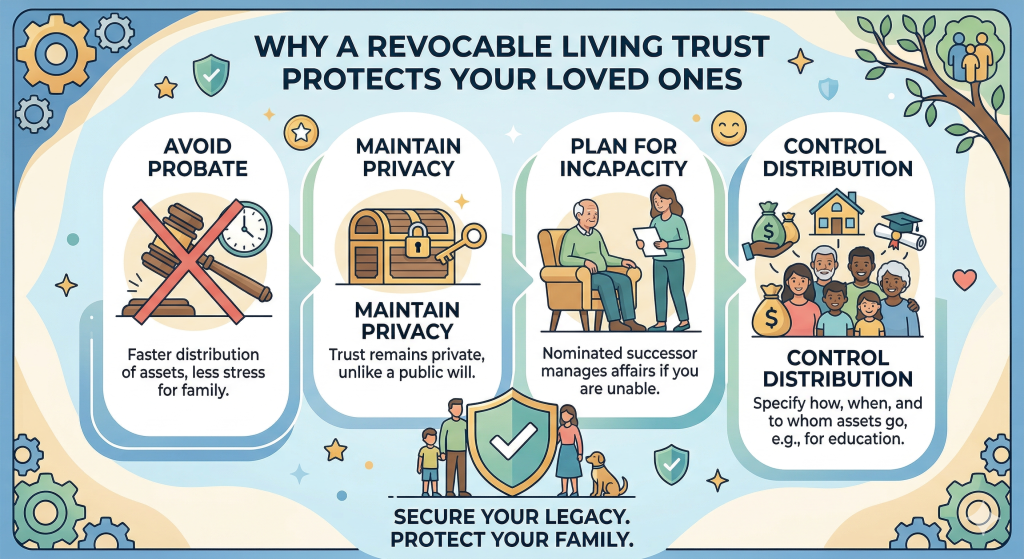
Benefits of a Revocable Living Trust
1. A Trust is the Best Tool to Protect You and Your Loved Ones from Your Death or Incapacity
2. A Trust Avoids the Public Superior Court Probate Money Pit
In Arizona, if your Arizona real estate exceeds $300,000 or your personal property exceeds $200,000, your estate is headed for a public Superior Court probate. The purpose of a probate is to pay the expenses of the deceased and transfer the deceased’s assets to the heirs. In Arizona, probate isn’t just a “process”—it’s a financial predator. Between court filing fees, mandatory legal notices, and attorney fees, the system is designed to shave 3% to 8% off the top of your estate. For a modest $500,000 home, you are essentially writing a $25,000 check to the legal system that could have gone to your loved ones. We charge $5,000 for a simple uncontested probate, and it takes a minimum of five months. We had a client who wasted $125,000 in attorneys’ fees litigating over who would be the personal representative in a probate.
Assets in the trust avoid probate and pass immediately to the heirs named in the Trust Agreement.
3. Trusts Avoid the Nightmare & Costs of a Court-Ordered Conservatorship
Most people fear death, but they should also fear loss of their mental capacity more. If you suffer a stroke or dementia or lose your mental capacity and don’t have a trust, your family must go to court and ask an Arizona judge to declare you “incapacitated” and appoint somebody (called a conservator) who has the power to manage your financial affairs. The conservator could be somebody you would not want to have power over your assets. This process can be expensive. It requires an annual court accounting and a judge’s permission to spend your own money on your care. If your assets are in your trust and you lose your mental capacity, the co-trustee or the successor trustee named in your Trust Agreement has the power to manage the trust’s assets for your benefit.
4. Trusts Prevent Your Assets & Heirs from Becoming Part of the Public Probate Court Records
When a Will is probated in Arizona, your assets and heirs are included in a public document. Anyone—nosey neighbors, predatory “creditor” scammers, or estranged relatives—can go online and see exactly what you owned, who you owed, and who your heirs are. A living trust keeps your financial life where it belongs: behind closed doors. Trust assets and beneficiaries are private.
5. Trusts Avoid the 9-Month Freeze: Leaving Your Family in Financial Limbo
Probate in Arizona is rarely a “quick” process; even “simple” cases often drag on for nine to eighteen months. During this time, your bank accounts and assets may be frozen. Imagine your spouse being unable to pay the mortgage or your children’s tuition because your assets are locked in a court-mandated probate waiting room. A trust allows for instant access; a Will guarantees a delay.
6. Trusts Can Avoid Accidental Disinheritance in Blended Families
If you have children from someone who is not your spouse, your assets that are not in a trust is a recipe for disaster. You have effectively placed your children’s future in your spouse’s hands. If your spouse remarries or simply changes his or her mind after you’re gone, your biological children could be legally disinherited. A trust is the only way to lock in your children’s inheritance so no one can “erase” them after you’re gone.
7. The Young Heir Windfall: Funding a Disaster
Without a trust, Arizona law requires that your children receive their entire inheritance the moment they turn 18. Handing a young person a lot of assets is rarely a good idea. A trust allows your successor trustee to hold the child’s inherited assets, which is a “hand from the grave,” ensuring the money is used for education and basic needs rather than being blown by the youngster on fast cars and bad influences.
8. Avoid Ancillary Probate: The Double-Court Nightmare
Do you own real estate outside of Arizona? Without a trust, your family will have to endure a separate ancillary probate in every state in which you own land, plus one for your Arizona real estate. That means multiple probate lawyers, multiple court fees, and additional delays. This “ancillary probate” reality is a logistical and financial nightmare that could be easily avoided by holding all your real estate in a trust.
9. The Special Needs Trap: Accidentally Ending Government Benefits
If you leave an inheritance directly to a loved one with special needs, that would instantly disqualify the special needs person from receiving vital government benefits like AHCCCS, SSI, or Medicaid. They will be forced to “spend down” your hard-earned legacy on basic care until they are impoverished again. A trust protects their quality of life without jeopardizing their safety net. Our trust agreements contain language that if a future beneficiary is or becomes a special needs person, then that person’s trust will automatically become a special needs trust, so he or she does not lose any government benefits.
10. The Litigation Magnet: Why Wills Invite Lawsuits
Wills are surprisingly easy to contest in Arizona. Because the probate process requires notifying all “interested parties,” it practically invites disgruntled relatives to file a lawsuit. Trusts are difficult to overturn because they are private, ongoing entities that you managed while you were alive, making “undue influence” claims much more difficult to prove.
11. The Spendthrift Risk: a Trust Can Protect Your Heirs’ Inheritance from Creditors, Ex-spouses & Bankruptcy
Even if your children are adults, they may face lawsuits, bankruptcies, or messy divorces that could cause a loss of their inherited assets. If your loved ones inherit your assets in any way other than by a trust with a spendthrift clause, those assets are “fair game” for their creditors because the heir owns the inherited assets. A revocable living trust with a “spendthrift” clause creates a legal fortress around the inheritance, ensuring the money stays in the family and out of the hands of debt collectors or ex-spouses. Because your loved ones’ heirs’ inherited assets are retained in the trust, the heirs’ creditors, ex-spouses, and bankruptcy court cannot reach the assets because the loved ones don’t legally own the inherited assets.
12. Who Will Run Your Business If You Die or Become Mentally Incapacitated?
If you are a business owner, your sudden death or incapacity could paralyze your company. Without a trust, no one may have the legal authority to sign payroll, negotiate contracts, or manage employees until a judge appoints a personal representative in a probate. By the time the court acts, your business could be dead, its value evaporated, and your employees gone. If your trust owns your business and you die or lose your mental capacity, your co-trustee or successor trustee has the power to run the business
13. The Intestacy Lottery: Your State of Residence, Not You, Determines Who Inherits Your Assets
If you die without a Will or a trust, the law of your state of residence provides who inherits your assets. The state doesn’t care about your “black sheep” sibling, your favorite charity, or your lifelong partner. The state doesn’t care if you haven’t spoken to your child in 20 years or if you want to disinherit a family member. Your state’s law of intestate succession follows a cold, rigid formula that often results in assets going to people you do not want to inherit your assets. Arizona residents: To learn who will inherit your assets if you die without a will or a trust, see my article called “Who Inherits Your Property If You Die without a Will or a Trust” and take my short online quiz called “Who Inherits Your Property.”
14. Real Estate Titling Traps: The “Joint Tenancy” Delusion
Thinking of “just adding your child to the deed to your home” to avoid probate? You just handed your child’s creditors a lien on your house. If your child gets into a car accident or files for divorce, your home is now an asset that your child’s creditors can get. What you should do is transfer your home to your trust now or on your death or the death of both spouses if you are married. This avoids the potential problems that could arise if your child were on the deed to your home now.
15. The “Pet Orphan” Crisis
Under Arizona law, your pets are just “tangible personal property”—no different than a toaster. If you don’t have a trust with specific instructions naming their caregiver and funding for their care, your pets could be dumped at a kill shelter while your heirs argue over your jewelry. A trust ensures your “furry family” is never treated like garbage. It ensures your pets are cared for by the people you trust with the funds they need.
16. Divorce-Proofing Your Children’s Inheritance
Statistically, about half of marriages end in divorce. If your child inherits money from your Will and deposits it into a joint account with their spouse, that money becomes “community property.” If they later divorce, your hard-earned legacy could be handed over to an ex-son-in-law or ex-daughter-in-law. A trust keeps the inherited assets as “separate property,” protecting it from a failed marriage.
17. Immediate Peace of Mind: The “What-If” Stress
Living without a trust is like driving without insurance—you’re fine until you’re not. The constant, underlying stress of knowing your family is unprotected is a heavy burden. Living with the knowledge that your family is one accident away from a legal nightmare creates a constant, low-level “background radiation” of stress. A living trust is the only document that provides a comprehensive, “turn-key” solution for both life and death, allowing you to sleep at night knowing your estate plan is in place.
18. The Cost of Doing Nothing
The final “scare” is the math. You might save a few thousand dollars today by skipping a trust, but you are effectively “billing” your family tens of thousands of dollars in future probate costs, taxes, and legal fees. Failing to plan isn’t just a mistake—it’s a massive, unpayable debt you are leaving for your grieving family to settle. Don’t make your last act on earth a massive, avoidable financial burden for the people you love most.
Protect Your Loved Ones' Future Before Its too Late
Don’t leave your loved one’s future to chance. A revocable living trust offers unparalleled benefits, especially for married couples with minor children. Contact one of us today to schedule your free consultation and take the first step toward securing your family’s legacy.
Go to our online calendar to schedule a free office, phone, or Zoom video meeting to get answers to your questions and design your custom estate plan. We want to create your estate plan with a revocable living trust that safeguards your loved one’s financial security and legacy. You can also call Richard Keyt (the father) at 480-664-7478 or his son, Richard C. Keyt, at 480-664-7472.
36 Documents & Services in Our Custom Estate Plan
We doubt you will find an estate planning attorney whose estate plan includes as many documents and services as we provide. Look at other estate planning lawyers’ websites, and they usually don’t tell you what you get if you hire them or the fees they charge. We don’t hide the ball. See our estate plan fees and the 36 documents and services in our custom estate plan with a revocable living trust.
The first step to protect your assets and ensure they go to your desired heir(s) is to book a free office, phone or Zoom video consultation with one of our estate planning attorneys. During this no-obligation meeting, they will answer your questions and design your custom estate plan.
Call, email or text Richard Keyt, the father
Direct phone: 480-664-7478
Email: rk@keytlaw.com
Call, email or text Richard C. Keyt, the son
Direct phone: 480-664-7472
Email: rck@keytlaw.com